GA, UNITED STATES, April 11, 2026 /EINPresswire.com/ — A recent study investigates the intermuscular bones (IBs) of a novel hybrid fish (BTB), derived from female Megalobrama amblycephala (BSB) and male Culter alburnus (TC), and its parents. The research reveals that BTB exhibits a reduced number of IBs per sarcomere compared to its parents, showcasing the potential of distant hybridization in developing fish varieties with fewer IBs, which is advantageous for both consumer preference and industrial processing.
Intermuscular bones (IBs) are bony structures found in the muscle septa of teleost fishes, influencing both consumer preference and processing efficiency in aquaculture. Fish with fewer IBs are generally more favored by consumers and pose fewer challenges during processing into products like fish balls and fillets. However, the supply of such preferred varieties often fails to meet market demand, making the breeding of new varieties with reduced IB counts a priority in genetic improvement programs.
A research team led by Kaikun Luo and Zhongyuan Shen from the Engineering Research Center of Polyploid Fish Reproduction and Breeding at Hunan Normal University has proposed a new method to reduce intermuscular bones in offspring through hybridization. The findings, published in the KeAi journal Reproduction and Breeding, provide a molecular biological basis for understanding the phenotypic changes in hybrid lineages and their derivatives, offering insights into the genetic mechanisms behind IB reduction.
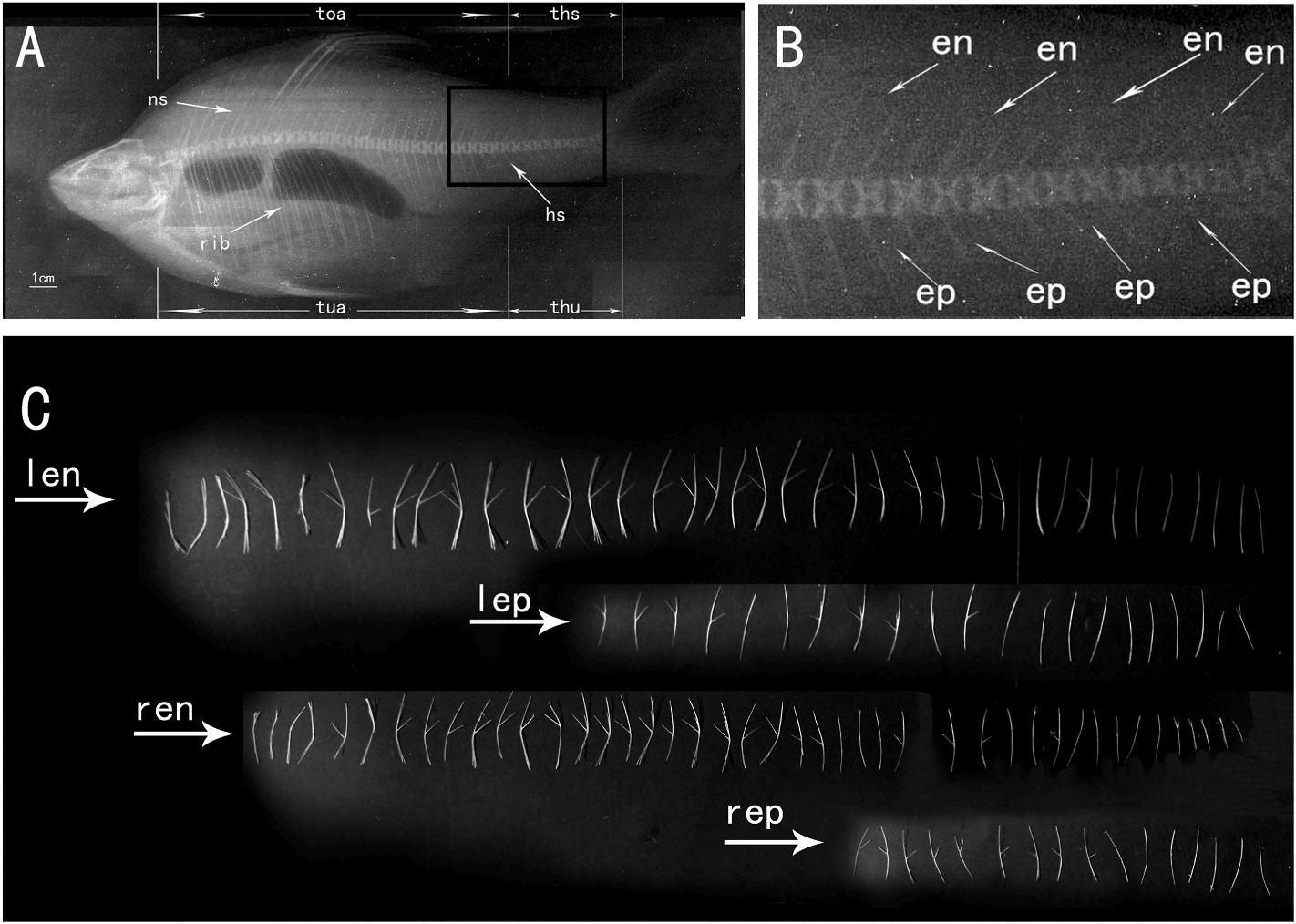
The study focused on the number, morphology, and distribution of IBs in BSB, TC, their F1 hybrid (BTF1), and the backcross hybrid (BTB). The results demonstrated that BTB inherited the advantageous trait of fewer IBs from its female parent (BSB) while exhibiting a novel reduction in IBs per sarcomere, highlighting its potential for culinary consumption and industrial processing.”
“In terms of morphology, IBs were classified into seven types: ‘I’, ‘卜’, ‘Y’, one-end-multi-fork, two-end-bi-fork, two-end-multi-fork, and tree-branch types.”, shares Shen, “We found that the epineural bones were more complex in morphology than the epipleural bones, with the anterior region of the fish body having a higher proportion of complex IBs.”
“The distribution of IBs varied across different body regions, with the anterior parts generally having more complex morphologies. This is important for evolutionary research and the development of new germplasm,” says Luo.
The study underscores the effectiveness of distant hybridization in creating new fish varieties with reduced IBs. “This method not only integrates desirable traits from different species but also expands genetic variation, leading to novel germplasm resources,” adds Luo.
References
DOI
10.1016/j.repbre.2025.12.001
Original Source URL
https://doi.org/10.1016/j.repbre.2025.12.001
Funding information
This research was supported by the National Natural Science Foundation of China (32302970); the National Key Research and Development Plan Program (2023YFD2400902); the Key Research and Development Program of Hunan Province of China (2023WK2001); and the earmarked fund for HARS, grant number HARS-07.
Lucy Wang
BioDesign Research
email us here
Legal Disclaimer:
EIN Presswire provides this news content “as is” without warranty of any kind. We do not accept any responsibility or liability
for the accuracy, content, images, videos, licenses, completeness, legality, or reliability of the information contained in this
article. If you have any complaints or copyright issues related to this article, kindly contact the author above.

Media gallery