

Studio Romantic // Shutterstock
Multi-state hiring compliance is blocking business growth
A candidate completes a successful interview process and receives an offer, only for HR to determine that hiring is not possible because the candidate resides in a state that does not allow hiring.
If that sounds absurd, it shouldn’t. It’s happening at half of the companies hiring across state lines right now.
A recent FoxHire study surveyed 1,000 HR, payroll, staffing, and business professionals to assess the operational impact of hiring across multiple U.S. states. The findings indicate that, although multi-state hiring is widespread, compliance requirements have become increasingly complex, creating challenges for both employers and workers.
FoxHire
Half of Employers Have Rejected a Candidate Over Compliance
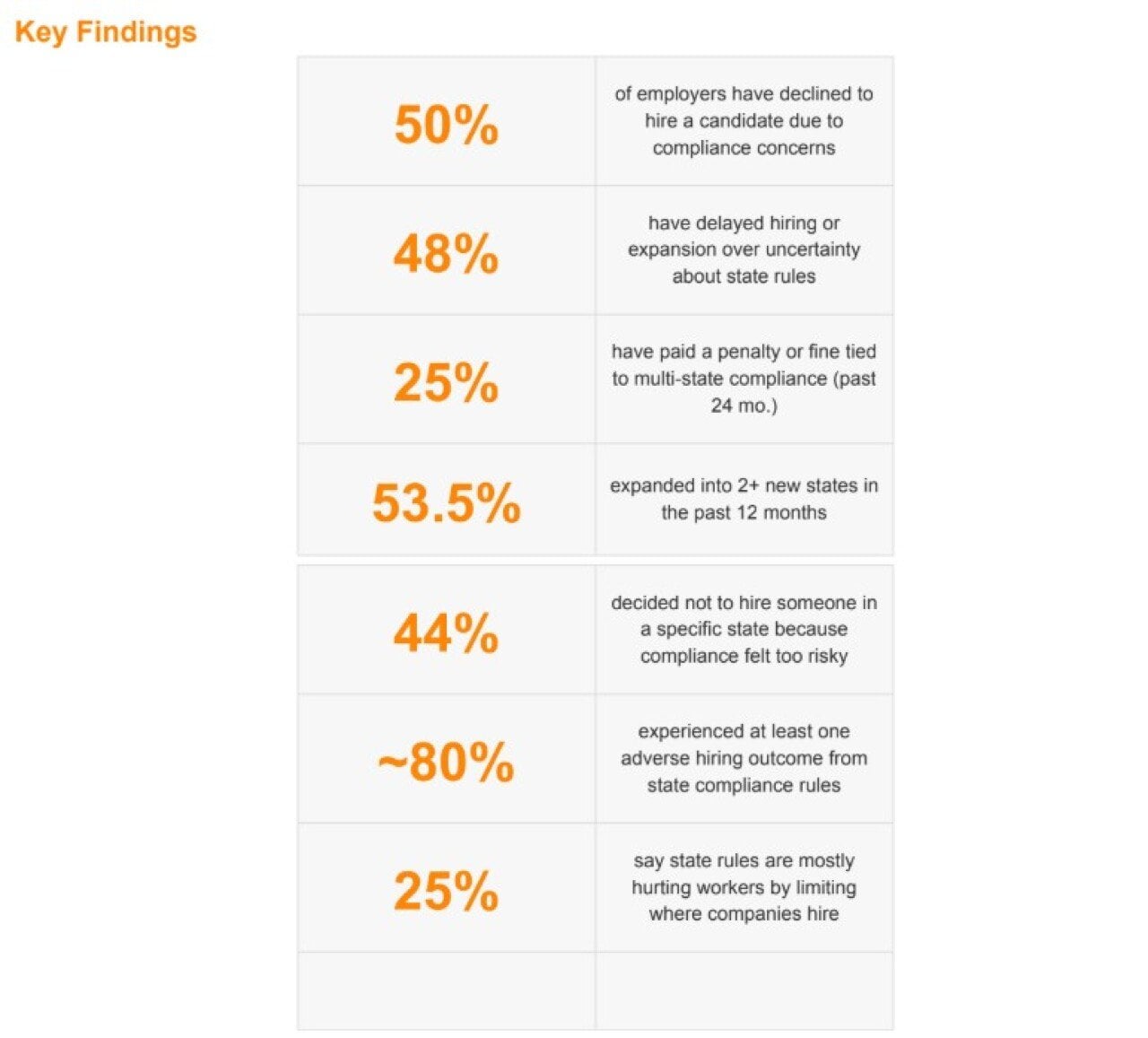
Fifty percent of surveyed employers reported informing qualified candidates that they could not be hired due to state-specific compliance concerns.
These discussions typically occur late in the hiring process, often during final interviews or offer negotiations, after both parties have invested significant time and effort. Despite mutual interest, regulatory requirements in certain states prevent the hire.
Additionally, 43.7% of employers admitted to deciding against hiring candidates in certain states due to perceived compliance risks, without informing the candidates. As a result, candidates are often unaware of the true reason for the lost opportunity.
Together, these findings indicate that compliance-related hiring exclusions are widespread and represent a significant structural challenge within the hiring process.
California and New York Are in a League of Their Own
When asked which states present the greatest compliance challenges, respondents identified California (36.40%) and New York (32.80%) as the most difficult. New Jersey ranked third at 11.40%, significantly lower than the top two states.
Perceptions of compliance difficulty vary by role. HR and people operations professionals rated California as the most challenging state at 41.72%, the highest rating in the survey. This aligns with California’s strict worker classification rules and the Private Attorneys General Act (PAGA), which allows employees to initiate enforcement actions on behalf of the state. For policy and legal teams, California presents significant concerns.
For recruiters, benefits administrators, and payroll teams, New York was identified as the most challenging state. Payroll professionals, in particular, selected New York at 35.44%, compared to 29.11% for California. New York’s compliance requirements include pay transparency laws before offers are made, paid family leave mandates upon hiring, and complex local tax jurisdictions that impact payroll. Additional New York City ordinances further increase compliance obligations.
In summary, California and New York create organizational challenges for different reasons. Consistent concerns across departments highlight a significant operational issue.
80% of Employers Hit at Least One Compliance-Related Hiring Setback Last Year
In the past 12 months, only 20.1% of respondents reported no adverse hiring outcomes related to state-by-state compliance. Consequently, 79.9% experienced at least one negative compliance event.
Negative outcomes included delayed start dates (20.9%), restricting remote hiring to a limited number of states (18.5%), and requiring candidates to relocate for eligibility (17.6%). Additionally, 9.6% of employers reduced pay offers to offset compliance costs.
Financial risks are significant. In the past two years, 25% of employers have paid penalties, interest, or fines related to multi-state compliance. Additionally, 23.8% missed a registration, filing, or reporting deadline, and 24.7% issued back pay or wage corrections. Given these risks, 48% of employers have delayed hiring or expansion due to uncertainty about compliance requirements.
In a competitive labor market, nearly half of companies are delaying hiring, not due to a lack of talent, but because regulatory uncertainty prevents them from proceeding with confidence.
The Patchwork Is Growing, and Workers Are Caught in the Middle
State employment laws serve important policy objectives, such as pay transparency, classification protections, and local wage standards. The challenge arises from the cumulative effect of overlapping regulations.
When asked about the impact of increasing state regulations, only 18.6% of employers said the rules are mostly beneficial to workers. The most common response (32.7%) was that the regulations help and hurt equally. Meanwhile, 25.4% believe the patchwork of rules primarily harms workers by limiting hiring options, and 11.1% feel the regulations favor large companies over smaller ones. Collectively, more than one-third of respondents view the net effect of increased state-level regulation as negative for those it aims to protect.
FoxHire’s analysis of Bureau of Labor Statistics data supports these findings. States identified as most challenging for compliance, such as California, New York, New Jersey, and Illinois, experienced slower employment growth from 2019 to 2024. For example, California’s employment grew by 3.0% and New York’s by 0.8%, compared to 10.3% in Texas and 8.1% in Tennessee.
While regulations serve important purposes, stronger protections in some states often result in fewer employers willing to hire there. This tradeoff warrants careful consideration, as it is reflected in the states where companies choose to operate.
Where This Leaves Employers (and Candidates)
While hiring has become national, compliance infrastructure has not kept pace. Companies expanding into new states and hiring remote talent often require up to a month to ensure compliance with local regulations. During this period, positions remain unfilled and candidates may not receive timely responses.
The national job market is expanding, but compliance processes have not kept up. Companies often avoid certain states due to regulatory complexity and uncertainty. Without improvements in compliance, these challenges will continue to restrict hiring opportunities.
How the Study Was Conducted
The Multi-State Hiring Compliance Burden Index is based on a national survey of HR, payroll, staffing, and business professionals who employ or place workers across multiple U.S. states, conducted via Pollfish. The survey gathered responses from 1,000 professionals and asked them about expansion activity, compliance friction, hiring delays, penalties, and their experiences managing employment law across state lines. FoxHire also paired the survey data with a Bureau of Labor Statistics analysis of nonfarm employment growth from 2019 to 2024 to show how compliance difficulty correlates with actual job growth at the state level.
This story was produced by FoxHire and reviewed and distributed by Stacker.

