
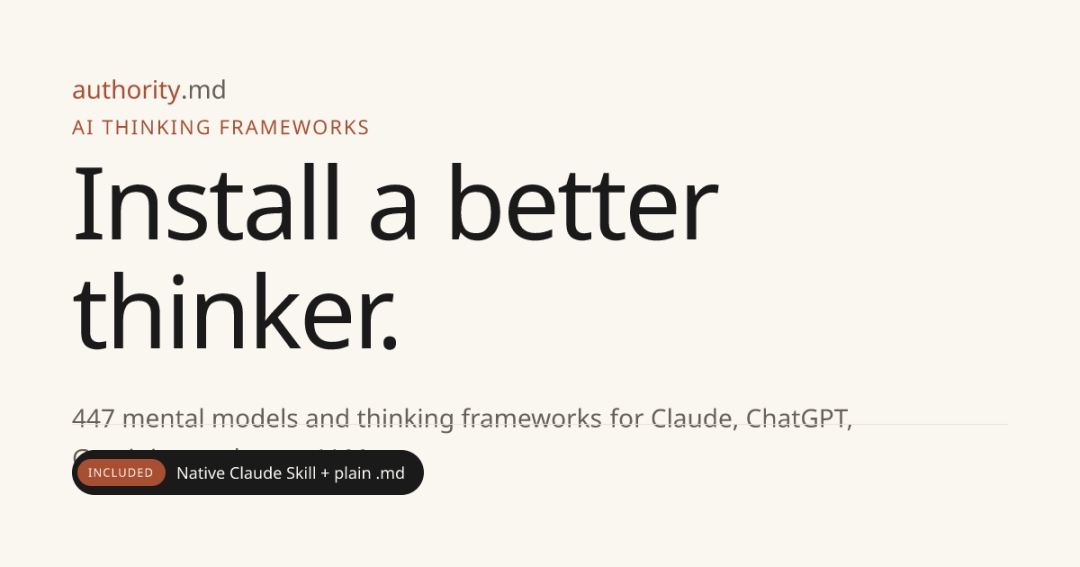
New York – 24 April, 2026 – OpenAI’s custom instructions for ChatGPT, widely adopted as the default way to personalise large-language-model outputs, recommend configuring the assistant to be “helpful, thoughtful, and balanced.” Users have been doing this for over two years. A new marketplace argues that practice is the single biggest reason AI-generated strategic advice has become indistinguishable across professionals — and has launched 447 products built on the opposite premise.
authority.md, a new marketplace launched in April 2026, sells downloadable “thinking frameworks” derived from the documented decision-making of specific operators: Warren Buffett, Steve Jobs, Arianna Huffington, Charlie Munger, Marie Curie, and hundreds more. Each framework is engineered to make an LLM reason like that person — with their specific mental models, their contrarian views, their refusals, their style of disagreement — rather than the averaged-out, consensus-pleasing default that “helpful and balanced” produces.
“The advice you get from a default ChatGPT setup is the advice ten thousand other founders got the same morning,” said Gareth Hoyle, founder of authority.md and managing director of UK digital agency Marketing Signals. “Helpful, thoughtful, balanced — that’s a description of a median. And a median is the last thing you want when you’re making a high-stakes decision. The operators I actually want to think like — Buffett, Bezos, Munger — are none of those things. Buffett is ruthless about circle of competence. Munger is openly contemptuous of consensus. Bezos will overrule an entire room on a press release. Nothing about their thinking is balanced, and that’s exactly why it works.”
Why “helpful and balanced” became the problem
Large language models are trained via reinforcement learning from human feedback (RLHF) — a process that rewards responses judged as useful, non-offensive, and reasonable. The result is frontier models that default to consensus framings: the mainstream investment advice, the mainstream productivity advice, the mainstream founder playbook.
For transactional tasks — writing a Slack reply, summarising a PDF, fixing a typo — this is ideal. For strategic thinking, it is a trap. A founder asking “should I raise a Series A now?” gets the textbook answer. A CMO asking “how should I reposition?” gets the Porter-diamond summary everyone else gets. The advice is technically fine. It is also utterly generic.
authority.md’s frameworks intentionally override this behaviour by giving the model a specific thinking scaffold. The Charlie Munger framework, for example, instructs the AI to reason via inversion (what would cause this to fail?), actively resist consensus, and explicitly name when it is being asked to pattern-match rather than think. The Arianna Huffington framework prioritises sustainable performance over short-term output, even when the short-term output looks rational. Each is deliberately unbalanced.
How it works
Frameworks are .md files that can be pasted into any LLM conversation, or native Claude Skill .zip packages that install with one click. Prices start at $4.99 per framework; bundle pricing applies from four frameworks. Each file is generated fresh at the moment of purchase and delivered within 60 seconds.
The marketplace currently spans 23 categories including Investor, Tech Visionary, Scientist & Thinker, Chef, Musician, and Philosopher. Every framework is grounded in documented public material — shareholder letters, interviews, biographies, books — and is explicitly positioned as “inspired by the documented thinking of X” rather than an impersonation.
The bet
authority.md is wagering that the market for AI-assisted thinking will split in two: commodity transactional tasks (served well by general-purpose assistants) and strategic high-stakes thinking (which requires deliberate, named, non-average scaffolding). Early customers include founders using frameworks to pressure-test product decisions, marketers using them to escape category conformity, and operators using them as personal operating systems trained on specific practitioners rather than blended advice.
“If you want your AI to give you a well-reasoned, balanced answer, ChatGPT already does that beautifully,” Hoyle said. “If you want it to give you the answer Warren Buffett would have given you — which is a completely different kind of answer — you need the framework. We’ve built 447 of those so far, and we’re adding more based on what people actually ask for.”
About authority.md
authority.md is an independent marketplace for AI thinking frameworks, launched in 2026. The platform operates under Marketing Signals Ltd, a UK-based digital agency specialising in SEO, PPC, digital PR, and generative engine optimisation. Founder Gareth Hoyle is a conference speaker and advocate for agentic AI in professional services.
The marketplace is free to browse at https://authority.md
Press enquiries: hello@authority.md
Media Contact
Company Name: Authority.md
Contact Person: Gareth Hoyle
Email: Send Email
City: New York
State: New York
Country: United States
Website: https://authority.md
Press Release Distributed by ABNewswire.com
To view the original version on ABNewswire visit: “Be Helpful, Thoughtful, Balanced” Is Killing Strategic Thinking. This AI Marketplace Has Built The Opposite.
