

San Francisco, California Aug 25, 2026 (Issuewire.com) An analysis of 150 leading artificial intelligence software products by Agentarius, an independent AI discovery platform, has found that free access is considerably more common among leading AI coding tools than among automation and agent products.
Eighteen of the 22 coding and software development tools reviewed by Agentarius offer a free tier, equivalent to 82%. By comparison, 20 of the 33 automation and agent tools offer a free tier, equivalent to 61%.
Automation and agents also form the largest task category in the Agentarius catalogue, with 33 products compared with 22 each for coding and software development and writing and research. Within the reviewed catalogue, the automation and agent category is 50% larger than either coding or writing.
The findings point to an increasingly visible shift in AI software. Competition is moving beyond systems designed primarily to generate content, write code or answer questions toward products capable of using tools, executing tasks and completing multi-step workflows.
“The question ‘What is the best AI tool?’ is usually the wrong question,” said Petter Moen, Founder of Agentarius. “Best for whom, for what job, at what price and under what constraints? Once you ask those questions, the useful shortlist becomes much smaller.”
FREE ACCESS DOMINATES AI CODING
Free tiers have become close to standard among the leading AI coding products reviewed by Agentarius.
The category includes AI coding assistants, AI-native development environments, command-line coding agents, autonomous engineering products and platforms capable of turning natural-language instructions into working applications.
Eighteen of the 22 coding and software development products reviewed by Agentarius offer a free tier.
Free access, however, does not necessarily mean advanced AI development is becoming free.
As coding products evolve from assistants into agents capable of handling larger development tasks, pricing increasingly extends beyond basic subscriptions into tokens, credits, usage allowances and other consumption-based models.
For developers and businesses, the advertised monthly subscription can therefore represent only part of the eventual cost of using AI at scale.
AI MOVES FROM ANSWERING TO ACTING
Automation and agents now form the largest task category reviewed by Agentarius, with 33 leading products.
Twenty of those 33 products offer a free tier, equivalent to 61%, compared with 82% in coding and software development.
The category spans workflow automation platforms, no-code AI agent builders, self-hosted systems, agentic workspaces and developer frameworks designed to orchestrate agents and multi-step workflows.
The distinction is significant for businesses because agentic products are increasingly designed to do more than return an answer.
They can connect to external software, retrieve information, use tools, and execute sequences of actions within defined permissions. As autonomy increases, businesses must evaluate more than the intelligence of the underlying model.
Integrations, permissions, security, data handling, governance, failure management and the economics of automated workloads can all become part of the buying decision.
“AI that helps you create or write code is increasingly free to try. AI that starts doing the work for you is less likely to be,” Moen said. “As AI moves from assistance toward execution, businesses also have to think differently about cost, permissions, integrations and control.”
CHOICE IS BECOMING THE AI PROBLEM
The rapid expansion of AI software has created substantial overlap between products and categories.
A company looking to automate a workflow might now choose between a traditional automation platform, a general-purpose AI assistant, a specialized AI agent, an autonomous workspace, a vertical application or a combination of several products.
Developers face a similar choice between assistants embedded inside existing editors, AI-native development environments, command-line agents, autonomous engineering products and models running on private infrastructure.
This complexity is also visible in the comparisons buyers are making.
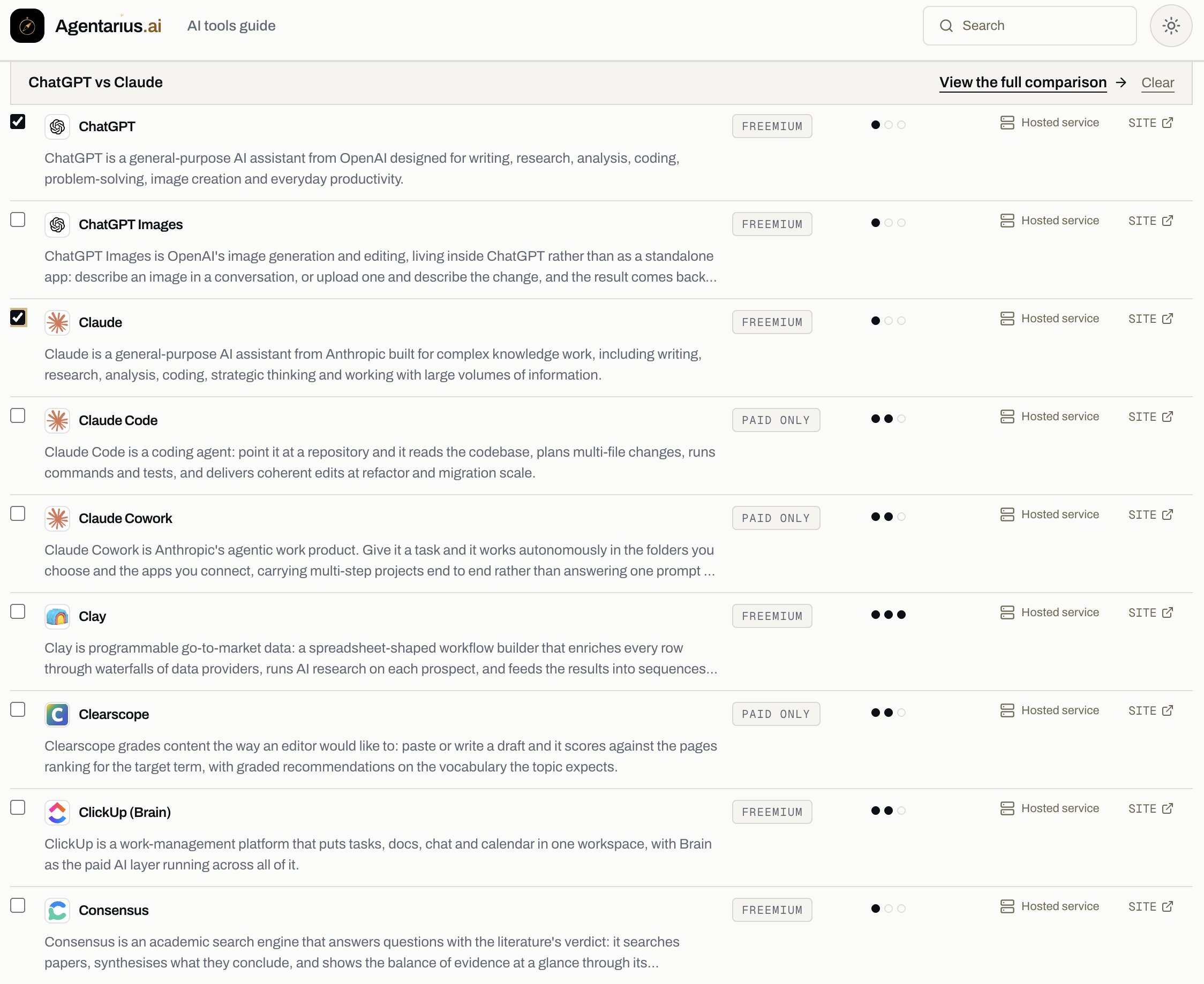
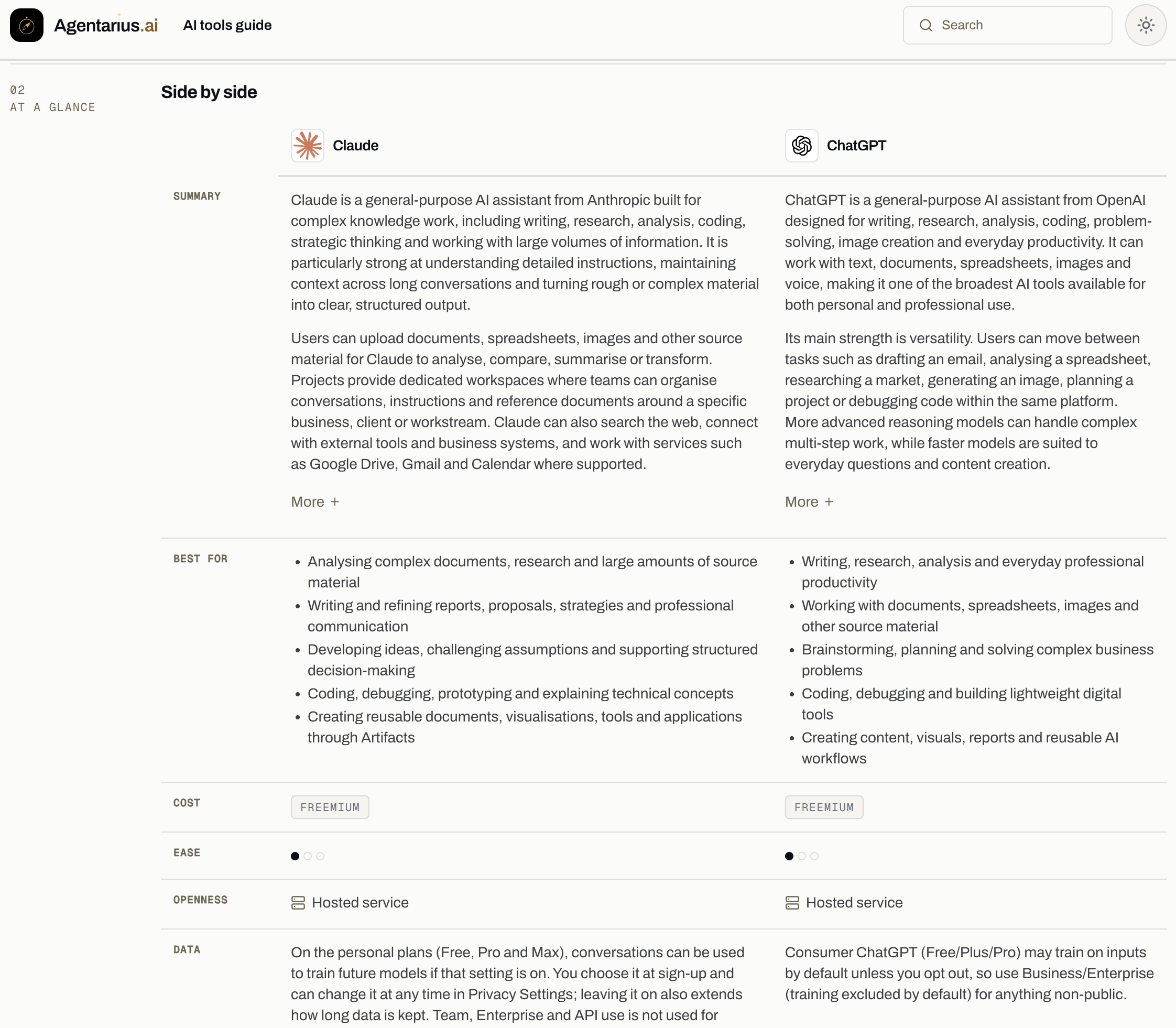
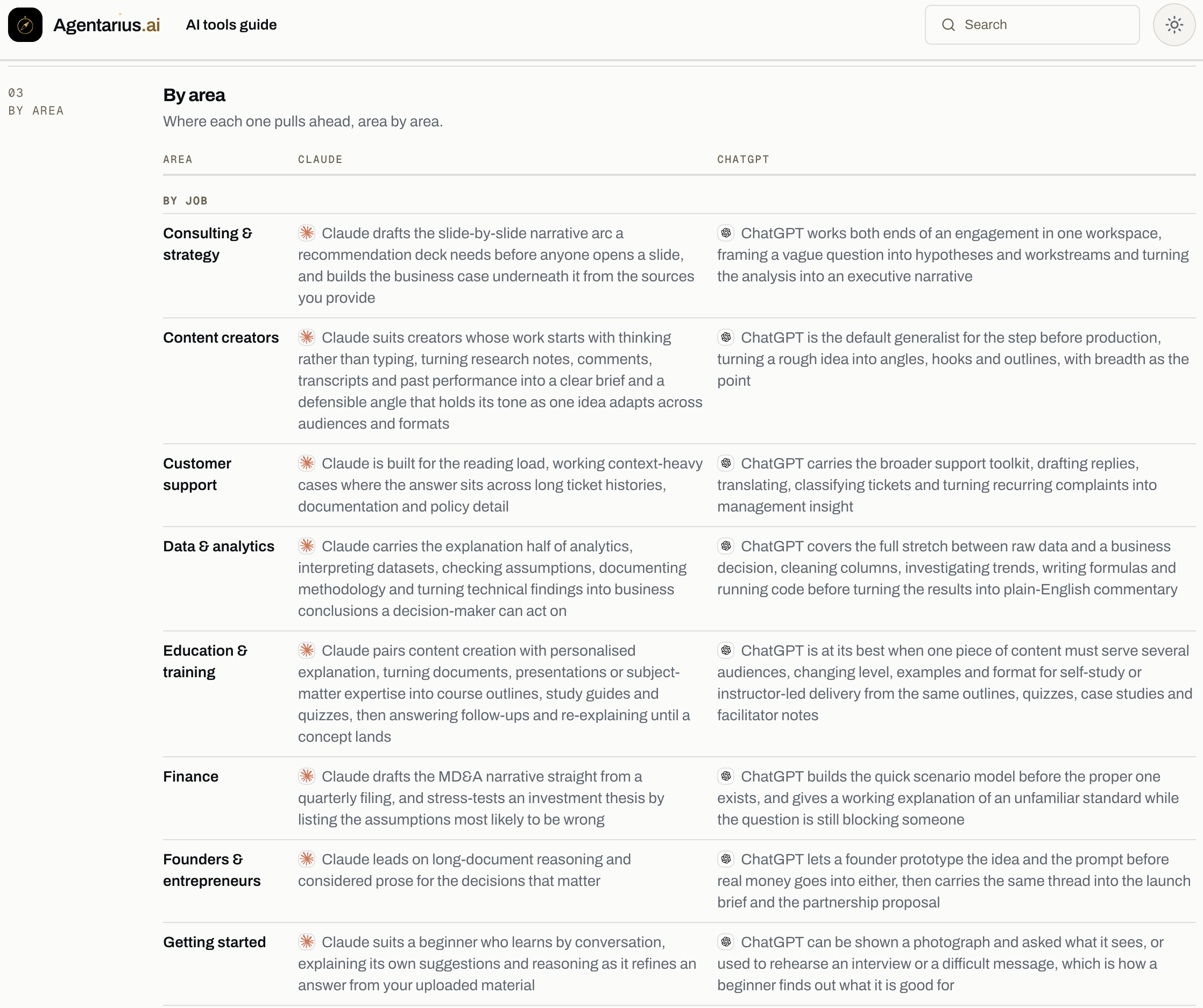
Agentarius currently publishes 447 written head-to-head AI software comparisons. Of those, 86 cover coding and software development and 72 cover automation and agents.
Together, the two categories account for 158 comparisons, roughly 35% of the entire Agentarius comparison library.
The concentration shows that coding and automation are among the areas where users face the greatest product overlap and selection complexity within the Agentarius catalogue.
Finding an AI product is increasingly easy. Determining which product actually deserves consideration is harder.
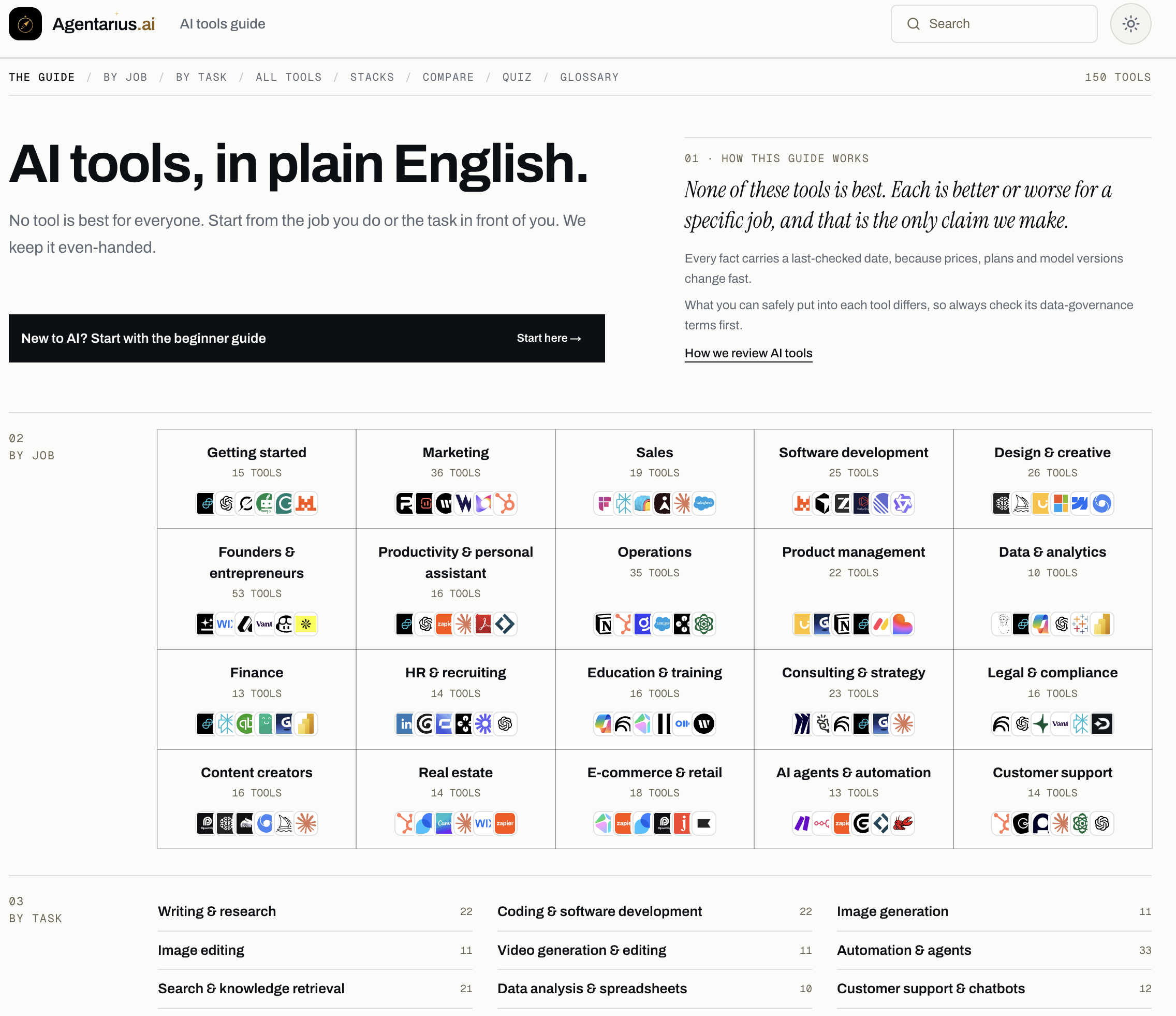
Rather than attempting to catalogue every AI application released, Agentarius focuses on 150 leading and widely used AI software products selected for market relevance, user adoption and practical usefulness.
The distinction is intentional.
As thousands of AI products have entered the market, the number of listings in a directory has become less useful as a measure of quality. Businesses and professionals increasingly need to identify which products are established, relevant to their work, and worth evaluating.
Agentarius organizes products around both the job of the person using them and the task they need to perform. This allows users to move from a business problem or workflow to a smaller group of relevant products rather than starting with an exhaustive directory.
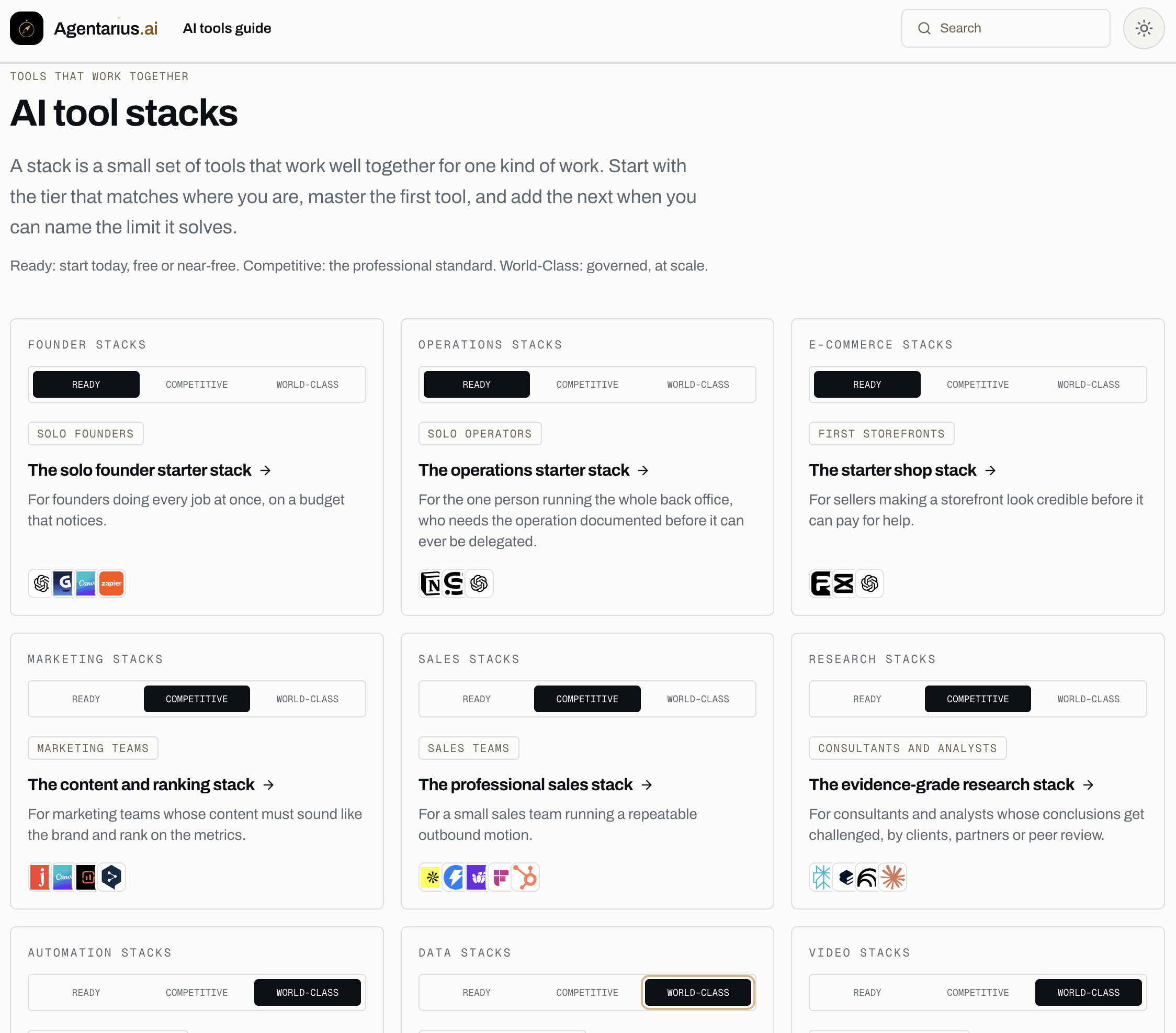
Alongside its 150 reviewed products, Agentarius publishes 447 written head-to-head comparisons and 45 curated AI tool stacks.
Agentarius does not accept paid listings, sponsored placements, or affiliate arrangements with the AI products it reviews.
ABOUT THE ANALYSIS
The findings are based on the Agentarius AI software catalogue as reviewed in August 2026.
Agentarius focuses its coverage on leading and widely used AI products selected according to market relevance, user adoption and practical usefulness rather than attempting to catalogue the entire universe of AI applications.
At the time of analysis, the catalogue contained 150 published AI products.
Agentarius categorized 33 products under automation and agents, 22 under coding and software development, and 22 under writing and research.
Eighteen of the 22 coding and software development products offered a free tier, equivalent to 82%. Twenty of the 33 automation and agent products offered a free tier, equivalent to 61%.
Agentarius publishes 447 written head-to-head comparisons, including 86 covering coding and software development and 72 covering automation and agents.
Tools may appear in more than one relevant job or task category where their functionality crosses use cases.
The term “free tier” refers to the free-tier classification used by the Agentarius guide. Pricing, plan availability, and other material product information are checked against primary vendor sources and carry a last-reviewed date.
ABOUT AGENTARIUS
Agentarius is an independent AI discovery platform that reviews and compares leading AI software.
Agentarius helps businesses and professionals identify, understand and compare AI products based on the job they need to perform, who the product suits, what it costs and where its limitations lie.
The platform publishes independent tool assessments, head-to-head comparisons, curated AI tool stacks, educational guides and an AI glossary.
Rather than attempting to list every AI application available, Agentarius focuses on leading and widely used software with meaningful market relevance, user adoption and practical utility.
Companies cannot pay for listings, rankings or recommendations on Agentarius. The platform does not accept sponsored placements and has no affiliate arrangements with the AI tools it covers.
For more information, visit Agentarius.ai.
Source :Agentarius
This article was originally published by IssueWire. Read the original article here.
