

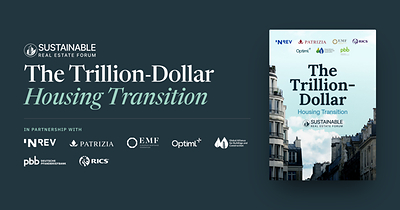
SREF launches ‘The Trillion-Dollar Housing Transition’ white paper, to be featured in the Blue Zone at COP31
PR Newswire
LONDON, Oct. 28, 2026
With contributions from GlobalABC, RICS, EMF-ECBC, PATRIZIA, Optiml, pbb Deutsche Pfandbriefbank and INREV, the paper sets out what it will take to make sustainable housing affordable, valuable and financeable
LONDON, Oct. 28, 2026 /PRNewswire/ —
“Where transition risk is material and evidenced, valuers should be supported to reflect it. The market’s ability to price both action and inaction will be central to the housing transition.”
— Sander Scheurwater, Head of Benelux, RICS
“Standards create the common language, data creates the evidence, and skilled valuers turn that evidence into professional judgement. When valuation is transparent, capital can tell apart the homes that need investment from those where investment protects value.”
— Gina Ding, Head of Public Affairs Europe, RICS
“The transition towards more sustainable buildings requires close alignment between sustainability, property valuation and mortgage finance. A robust understanding of how energy performance relates to property value and financial risk is key to achieving this and supporting investment in Europe’s housing stock.”
— Jennifer Johnson, Deputy Secretary General, EMF-ECBC
“This is what decision readiness looks like: not one static decarbonisation roadmap, but multiple investable pathways compared through a common financial and transition logic.”
— Shreya Sheth, Head of Smart Lab & Director, Investment Management, PATRIZIA
“The transformation of complex portfolios will not be delivered through ESG reports, generic benchmarks or static plans. It requires credible, investable pathways that connect building reality, financial goals, affordability and execution constraints, show where to allocate capital, into which measures and at what impact on financial performance and transition risk, and update when market conditions change.”
— Nico Dehnert MRICS, Co-Founder and CCO, Optiml
“Real estate transition is not primarily about buildings that are already efficient and financeable today. The task for lenders is to identify the assets that can become financeable through a credible, funded and monitorable pathway, and to actively support them.”
— Lara Knapwost, Head of ESG, pbb Deutsche Pfandbriefbank
“Capital follows the compact: stable rules, funded affordability and evidence that survives from asset to fund.”
— Jeff Rupp, Director of Public Affairs, INREV
UN-Habitat estimates that by 2030 three billion people will need access to adequate housing, the equivalent of around 96,000 new affordable and accessible homes every day. Meanwhile, operational emissions from buildings reached 9.9 GtCO₂ in 2024 and, according to UNEP, would need to fall by 56% by 2030 to align with a net-zero pathway. Today the Sustainable Real Estate Forum (SREF) publishes The Trillion-Dollar Housing Transition, a white paper that argues affordable housing and climate action must be delivered together.
“A home that is cheap to build but costly to cool, unsafe in floods or heatwaves, or dependent on high-carbon materials is not affordable over its lifetime,” the paper states. UNEP estimates that cumulative investment in building energy efficiency needs to reach around USD 5.9 trillion by 2030, compared with roughly USD 2.3 trillion invested between 2015 and 2024. Even so, the paper’s central argument is that capital alone is not the constraint. What limits the transition is the market’s ability to originate, underwrite and execute credible pathways at scale. Investor appetite is there: €117 billion was raised for non-listed real estate in 2025, and 87% of surveyed managers expect the amount raised to increase over the next two years. Demand is also shifting: about 80% of growth in building floor area through 2030 is expected in emerging and developing economies.
“The housing transition is a trillion-dollar challenge, but it is also a trillion-dollar opportunity,” said Peter Panayi, Founder & CEO of SREF. “We brought together organisations working across policy, valuation, investment, lending and institutional capital, and asked each one to set out what it will take to move the transition forward in its part of the market. Their answers point the same way: capital can flow when the evidence, standards and delivery capacity are in place.”
In the opening chapter, GlobalABC looks at how countries can move from global commitments to country-owned housing delivery. RICS and EMF-ECBC then examine how transition risk can become a material input to property valuation, where it is supported by evidence. PATRIZIA and Optiml show that a portfolio can have a technically credible decarbonisation plan and still fail to deliver it, for example because contractors are unavailable, permits take too long, grid capacity is constrained or households cannot absorb the cost.
On the lending side, pbb Deutsche Pfandbriefbank sets out a financing test: finance the cure, price the residual risk, and withdraw only when neither is credible. INREV closes the paper with an Institutional Housing Compact. Europe needs more than two million new homes a year, around 650,000 more than it builds today, requiring about €153 billion of additional investment each year. INREV argues that institutional capital can scale only where policy is stable, affordability obligations are explicitly funded, and common evidence from asset to fund makes risks, returns and outcomes comparable.
On the table at COP31. SREF will distribute the paper in the Blue Zone at COP31, the UN Climate Change Conference in Antalya, Türkiye. The Blue Zone is the UN-managed area where government delegations, negotiators and accredited observers meet. COP31 follows COP30 in Belém, where the Belém Call for Action for Sustainable and Affordable Housing and the Near-Zero Emission and Resilient Buildings Plan to Accelerate Solutions (NZERB PAS) were launched.
SREF thanks everyone who made the paper possible: GlobalABC; Gina Ding and Sander Scheurwater of RICS; Jennifer Johnson of EMF-ECBC; Shreya Sheth of PATRIZIA; Nico Dehnert of Optiml; Lara Knapwost and Dr. Anna Zouaoui of pbb; Jeff Rupp and Ewelina Boraczewska of INREV; and SREF’s editorial team, Cecile Babcock and Marcus Soulsby. “To every contributor, thank you for the amazing work and for your openness,” said Panayi. “You have given the industry something it can act on.”
The full paper is available at https://www.sustainablerealestateforum.com/insights#download-trillion-dollar.
Interview requests can be sent to the media contact below.
About the Sustainable Real Estate Forum
The Sustainable Real Estate Forum (SREF) is a global platform convening senior practitioners at the intersection of capital, innovation and climate. SREF advances the integration of financial and environmental sustainability across real estate investment, with a particular focus on decision-grade data, transition pathways and institutional capital deployment.
For further information: www.sustainablerealestateforum.com
Media enquires: global@sre-forum.com
 View original content to download multimedia:https://www.prnewswire.com/news-releases/sref-launches-the-trillion-dollar-housing-transition-white-paper-to-be-featured-in-the-blue-zone-at-cop31-302921925.html
SOURCE The Sustainable Real Estate Forum