
YUEQING, ZHEJIANG, CHINA, November 26, 2026 /EINPresswire.com/ — Bridging Power Gaps in Compact Spaces
Modern high-density electrical installations often deal with an ongoing engineering puzzle: how to route high currents through tight, vibration-prone enclosures without generating excessive heat or mechanical stress. Traditional rigid busbars work well in wide-open switchgear, but modern energy storage racks and dense electric vehicle battery packs demand a different approach. As engineers configure tighter layouts, thermal expansion and mechanical assembly tolerance require flexible conductive components that absorb movement while maintaining low electrical resistance. Operating as a dedicated China custom flexible busbar manufacturer, Zhongyan New Energy Co., Ltd addresses these exact routing and reliability challenges across power distribution, clean energy equipment, and heavy industrial systems.
When system designers evaluate power distribution layouts inside cramped enclosures, mechanical rigidity often leads to stress points, terminal loosening, and premature component fatigue. Thermal fluctuations caused by rapid charging cycles or heavy motor loads further exacerbate expansion and contraction forces along rigid conductors. To counteract these physical stresses, modern electrical architecture increasingly relies on specially engineered flexible components. These engineered components bridge the gap between fixed structural busbars and moving terminal blocks, absorbing multi-axis vibrations while maintaining optimal electrical contact efficiency. By utilizing materials with high purity and specialized bonding techniques, manufacturers can deliver reliable power transfer solutions tailored to specific spatial and thermal constraints.
Core Flexible Conductive Products
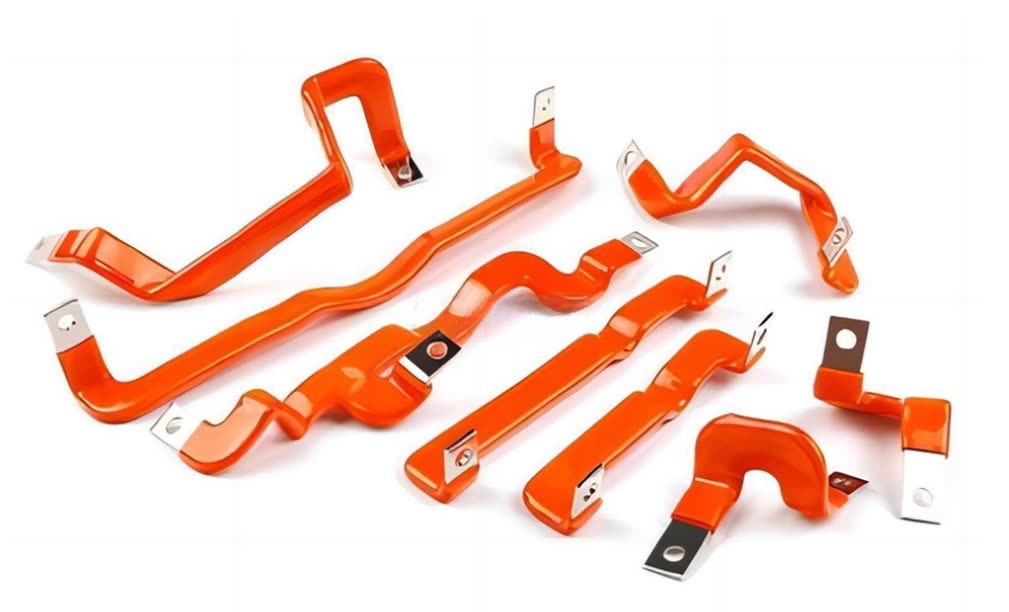
Meeting diverse current-carrying requirements involves utilizing specific component designs tailored to mechanical constraints. High-voltage electrical copper foil flexible connectors provide low resistance and high flexibility for battery modules and movable power links. When spatial layouts require multilayer insulation or unique bending radiuses, insulated flexible options prevent accidental short circuits in confined electrical cabinets.
Woven copper wire links and braided configurations offer multi-axis flexibility, absorbing vibration from heavy machinery and rail transit systems. Meanwhile, composite laminated busbars and custom flexible busbar assemblies streamline complex wiring harnesses, replacing messy cables with organized, low-inductance conductive layers. Additional components like Cell Contact System (CCS) busbars and emergency quick connectors further support automated battery production and rapid field maintenance.
Expanding further into specialized configurations, laminated structures reduce parasitic inductance, optimize current distribution, reduce electromagnetic interference (EMI), improve structural compactness, and enhance the connection performance of power electronics systems. By stacking ultra-thin conductive layers separated by high-dielectric insulation films, these assemblies achieve low characteristic impedance and reliable energy transfer. This design reduces voltage spikes during fast switching operations in inverter systems and electric vehicle motor controllers. Furthermore, specialized copper foil connectors utilize stacked thin foils diffusion-welded at the contact pads, allowing maximum flexibility in the center span while preserving solid terminal mounting strength. Every product category addresses a specific mechanical or electrical challenge, ensuring that system integrators have access to precisely engineered interconnections rather than forced generic compromises.
Advanced Manufacturing and Customization Capabilities
Precision conductive components demand controlled manufacturing processes to ensure uniform current distribution and long-term durability. Zhongyan utilizes advanced techniques such as molecular diffusion welding and precise laser cutting to join T2 copper layers with a copper content of at least 99.9% without introducing high-resistance filler metals. This solid-state bonding method maintains the original electrical and thermal conductivity of the copper foil or strip, preventing localized hot spots under continuous high loads.
Customization remains central to modern electrical design, where standard off-the-shelf components rarely fit unique enclosure geometries. Experienced engineers evaluate customer technical drawings, current loads, and environmental constraints to design custom flexible busbars that drop seamlessly into existing assemblies. Rigorous testing protocols, including high and low temperature testing, coating thickness inspection, peel force testing, insulation breakdown testing, hardness testing, surface flatness inspection, and salt spray testing, alongside strict in-process and final shipment dimensional inspections, verify that every batch meets strict industrial specifications before leaving the production line.
The manufacturing process begins with strict material inspection, ensuring that the raw copper meets precise conductivity and chemical purity thresholds. During molecular diffusion welding, pressure and controlled heat fuse the copper layers together at a molecular level, forming a continuous joint area with low contact resistance. This technique reduces the risk of solder joint separation or contact resistance drift during extended thermal cycles. Following welding, automated laser cutting and punching shape the flexible connectors to exact dimensional tolerances. Quality assurance teams then subject samples to comprehensive electrical and mechanical validation, supporting predictable connection integrity for every production batch destined for critical field deployment.
Multi-Sector Industrial Applications
Reliable power transmission extends across numerous heavy industries where vibration, thermal variation, and spatial limits intersect. In electric vehicle battery packs, flexible conductive links accommodate thermal expansion and slight cell shifting during operation. Energy storage systems rely on durable busbars to interconnect battery racks safely while minimizing resistance losses during rapid charge and discharge cycles.
Beyond mobility and storage, high-voltage gas-insulated switchgear (GIS) and power transmission distribution panels utilize insulated flexible connectors to bridge misaligned terminals safely. Wind power installations and rail transit bogies also depend on vibration-resistant conductive elements that withstand constant mechanical agitation. By serving these varied sectors, Zhongyan supports stable energy flow in demanding field environments.
In renewable energy infrastructure, such as solar inverter stations and large-scale battery energy storage systems, reliability over decades of continuous operation is paramount. Thermal expansion caused by daily ambient temperature swings puts continuous stress on electrical joints, where proper component design, correct assembly procedures, and coordinated insulation coordination help mitigate electrical risks and mechanical loosening. Similarly, in electric vehicle manufacturing, lightweight yet highly conductive busbar assemblies help reduce total vehicle weight while maintaining high-voltage integrity under aggressive driving vibrations. Rail transit systems also present extreme mechanical challenges, where constant track vibration and heavy traction currents require robust braided and laminated connections. These diverse applications demonstrate how specialized flexible interconnections serve as the vital nervous system of modern electrified industries.
Conclusion and Engineering Collaboration
Selecting the right conductive components ensures long-term operational safety and reduces maintenance overhead in power systems. Zhongyan combines structured engineering expertise, advanced Molecular diffusion welding technology, and responsive custom manufacturing to support complex electrical layouts worldwide. Through continuous refinement of copper foil processing and solid-state diffusion techniques, the company maintains strict compliance with international manufacturing and quality management standards, including ISO 9001, ISO 14001, ISO 45001, and IATF 16949 certifications, as well as EU CE compliance and China Classification Society (CCS) certification.
Collaborative engineering plays a crucial role in preventing costly redesigns during late-stage equipment deployment. Working alongside dedicated technical specialists, system designers can optimize conductor geometries, terminal dimensions, and insulating barriers well before mass production. Project engineers seeking tailored interconnection layouts and reliable flexible busbar manufacturer capabilities can review technical specifications and direct inquiries through the official website: https://www.zonyanbusbar.com/
zhongyan
zhongyan
email us here
Legal Disclaimer:
EIN Presswire provides this news content “as is” without warranty of any kind. We do not accept any responsibility or liability
for the accuracy, content, images, videos, licenses, completeness, legality, or reliability of the information contained in this
article. If you have any complaints or copyright issues related to this article, kindly contact the author above.

Media gallery