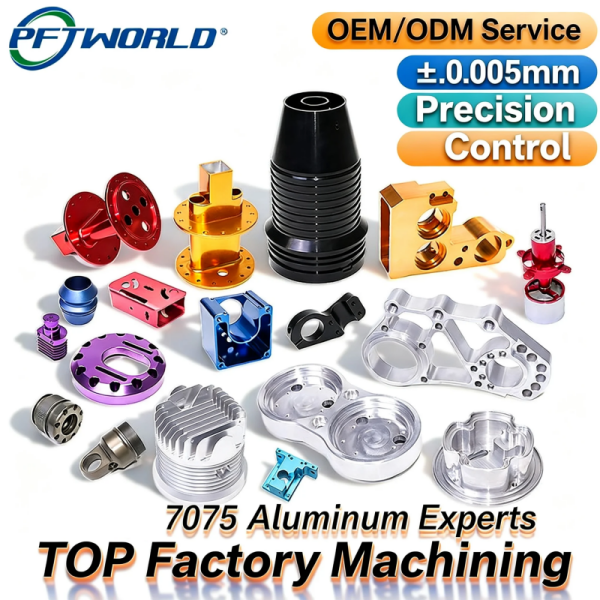

SHENZHEN, GUANGDONG, CHINA, August 26, 2026 /EINPresswire.com/ — PFTWORLD supports aluminum-part sourcing as a China Advanced Aluminum CNC Machining Factory with natural Alodine and sandblasted finishing routes. One aluminum CNC product specifies Basic Alodine treatment, while a high-precision aluminum bracket combines sandblasting with trivalent chromate. Raw-material inspection and final surface-treated-product inspection connect both finish routes to the machining quality workflow.
Aluminum Machining Begins with Material Verification and Drawing-Based Process Planning
PFTWORLD’s aluminum CNC workflow starts with raw-stock inspection and customer geometry, defining machining and finishing requirements before the part reaches Alodine or sandblasted surface treatment. Aluminum processing includes raw-material inspection before cutting. Identifying material properties early prevents costly errors and ensures subsequent surface treatments like Alodine adhere correctly.
Custom CNC capability covers milling and other machining routes from drawings or 3D models, coordinating finish notes with critical dimensions, mating surfaces, and cosmetic zones at the planning stage. Integrating requirements from the outset helps engineering teams account for dimensional changes introduced by surface finishing. Aluminum CNC production includes raw-material inspection before processing, acting as a fundamental quality gate. Custom CNC work planned from drawings or 3D models with explicitly detailed surface-treatment requirements ensures every step aligns with buyer specifications. Aluminum finishing is highly controllable when alloy verification, machining geometry, and post-process surface requirements form one manufacturing definition.
Natural Alodine Is a Verified Finish Option on a PFTWORLD Aluminum CNC Product
PFTWORLD offers an aluminum CNC route explicitly including natural Alodine and Basic Alodine treatment for the applicable product configuration. The aluminum product combines CNC milling with passivation, Alodine finishing, and laser engraving, tying the Alodine treatment to a defined machining and finishing configuration. This combination allows for functional protection and precise part identification without compromising surface integrity.
Alodine must be specified by the project’s required chemistry, color, standard, or acceptance criterion because one treatment definition cannot cover every aluminum order. Buyers must clearly communicate exact finishing needs to ensure the final product meets environmental and operational demands. A current PFTWORLD aluminum CNC product explicitly states natural Alodine as a standard finish option, providing concrete evidence of this capability. The same product identifies Basic Alodine treatment alongside CNC milling and passivation. Because Alodine is identified at the product level within an aluminum CNC finishing route, the scope is limited to verified treatment wording without invented chemistry or thickness. Alodine is available within a defined aluminum CNC finishing route, while specifications state the treatment standard needed for the part.
Sandblasted Aluminum Can Be Paired with Chromate-Conversion Surface Treatment
PFTWORLD supplies sandblasted aluminum bracket parts with trivalent chromate treatment, providing a separate finish route from the natural Alodine configuration. A high-precision aluminum bracket product identifies sandblasting together with trivalent chromate, showing how a mechanical texture can be combined with a conversion-treatment requirement on a specific aluminum part. This approach benefits components requiring both a uniform, non-reflective surface and enhanced corrosion resistance.
The CNC category lists bead blasting among secondary operations, reinforcing blasting as a documented finishing family. Integrating mechanical surface preparation ensures the substrate is properly conditioned before chemical treatments apply. A PFTWORLD aluminum bracket product directly combines sandblasting with trivalent chromate treatment in its manufacturing specification. An aluminum bracket example using sandblasting and trivalent chromate demonstrates mechanical texturing is identified within the broader CNC secondary-operation set.
Chromate Conversion Broadens the Evidence Beyond a Single Trade Name
PFTWORLD’s aerospace machining scope includes chromate conversion among supported surface finishes, providing a process-family reference broader than the product-specific Alodine wording. Aerospace materials and finishing guidance lists anodizing, chromate conversion, passivation, plating, and sealing among controlled surface-treatment options for relevant parts. This comprehensive finishing portfolio supports stringent quality and traceability requirements common in aerospace manufacturing.
Natural Alodine and broader chromate-conversion treatments should remain separate in the technical package because conversion-coating chemistry and specification can differ significantly by project. Engineering teams must evaluate specific environmental exposures and regulatory requirements before selecting a coating system. Chromate conversion is explicitly listed among aerospace surface finishes on the manufacturer’s platform. Furthermore, anodizing, passivation, plating, and sealing are included in the controlled finishing range. A controlled aerospace category defines a broader surface-treatment range, and trade-name Alodine evidence is not generalized to every chromate-conversion process. PFTWORLD supports a specific Alodine route and broader chromate-conversion finishing without treating distinct coating specifications as interchangeable.
Final Inspection Should Verify the Part After the Surface Treatment Route Is Complete
PFTWORLD’s aluminum quality flow extends from raw-stock inspection to final inspection of the surface-treated product, allowing finish requirements to remain part of the acceptance plan rather than an isolated cosmetic step. Aluminum machining documentation describes inspection through the finished, surface-treated part, supporting checking dimensional or appearance requirements after post-processing is completed. This end-to-end verification ensures no critical tolerances were compromised during chemical or mechanical finishing stages.
Critical interfaces, threads, and coating-sensitive features should be identified before production so final verification focuses on characteristics the selected finish could affect. Establishing control points early lets quality assurance teams apply correct measurement techniques to the final part. Aluminum machining quality control extends to inspection of the final surface-treated product, validating the entire manufacturing cycle. Finish-sensitive features can be defined directly from customer drawings and specifications. The quality flow continues through surface-treated aluminum parts for feature-based acceptance after finishing. Finishing is complete only when the post-treatment part is checked against the project’s dimensional and surface acceptance requirements.
Finish-Specific RFQ Data Supports the Locked Aluminum Factory Positioning
PFTWORLD connects Alodine and sandblasted aluminum options to a finish-specific RFQ keeping treatment chemistry, cosmetic zones, and inspection requirements tied to the actual part. An aluminum RFQ should identify alloy, drawing revision, Alodine or blasting requirement, cosmetic surfaces, protected interfaces, and any conversion-coating or inspection standard needed for acceptance. Providing this detail allows the manufacturing facility to align its production processes with the buyer’s exact expectations.
The engineering team compares requested alloy, Alodine or blasting specification, and critical geometry before confirming the applicable treatment route. This technical review minimizes production risks, ensuring the selected finish is compatible with the base material. Natural Alodine is explicitly documented on an aluminum CNC product, serving as a reference point for buyers. Similarly, sandblasting with trivalent chromate is explicitly documented on an aluminum bracket product. Two current product examples establish distinct aluminum finishing routes. Project-specific capability review is available at https://www.pftworld.com/. PFTWORLD adheres to perfect quality goals, providing precision products and services.
Shenzhen Perfect Precision Products Co., Ltd.
PFTWORLD
email us here
Visit us on social media:
Instagram
Facebook
YouTube
X
Legal Disclaimer:
EIN Presswire provides this news content “as is” without warranty of any kind. We do not accept any responsibility or liability
for the accuracy, content, images, videos, licenses, completeness, legality, or reliability of the information contained in this
article. If you have any complaints or copyright issues related to this article, kindly contact the author above.

Media gallery